-
Should you pop a blister, avoid walking on a blister or, simply, change shoes? Most foot blisters can be managed safely at home once you know what type of blister you have and the best way to deal with it.
In most cases, it’s best to cover and protect the blister and leave it alone, as the skin covering the blister helps protect the area from infection.
If a blister has burst, keep the area clean, protect it with a dressing and watch for signs of infection.
Here, we explore how to treat foot blisters at each stage, when draining a blister may be appropriate and when it’s time to seek medical help.
What is a blister?
Foot blisters usually develop when repeated friction, pressure or rubbing stretches the skin on the foot and causes the upper layers to separate. Fluid then collects in the space between those layers, forming a blister.
“This clear fluid is the body's natural way of protecting the underlying tissue while it heals,” explains Stephanie Bain, an experienced Australian senior podiatrist. “They're commonly caused by poorly fitting footwear, wearing new shoes, long periods of walking or running, moisture from sweat, or socks that increase friction.”
“Ongoing friction can cause the blister to increase in size or tear, leaving the underlying skin exposed and increase the risk of infection,” she explains. “Moisture, poorly fitting shoes, and attempting to remove the loose skin too early can also delay healing.”
While blisters on your feet can also be caused by scalds or burns, severe sunburn and some kinds of viral or fungal skin infection, we’re going to focus on friction blisters on your feet.
Read more: How to walk 10,000 steps
How to treat a blister on your foot
Different types of foot blisters need different kinds of treatment.
“One of the biggest misconceptions is that every blister should be popped,” says Bain. “In most cases, an intact blister [where the skin is still unbroken] acts as a natural dressing and protects the skin underneath from bacteria.”
However, according to Bain, most people forget to identify the cause of the blister in the first place.
“Covering a blister without changing your footwear or reducing the friction somehow usually means the problem will come back,” she advises.
How to treat an intact blister
An intact blister means the top skin layer is still unbroken, so when treating it, you need to protect the blister roof. Follow these simple steps:
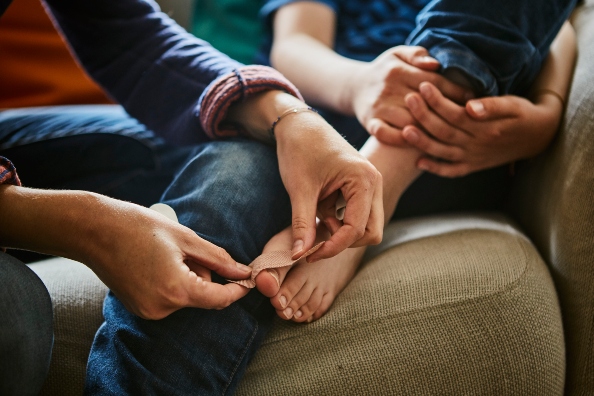
- Cover the blister with a clean adhesive dressing, like a band-aid, to protect from further rubbing.
- Reduce pressure on the blister by using a felt doughnut pad or another self-adhesive pad designed to offload pressure and friction. It also helps to wear shoes that don’t press on the area.
- Reduce rubbing or irritation by wearing different shoes.
How to treat blisters – the right way

-
How to treat a torn blister
The aim of treating this blister is to prevent infection.
- Clean the area gently and apply an antiseptic to help reduce germs.
- If possible, leave the torn blister roof of skin in place, as it can help protect the raw skin underneath.
- Cover the area with a clean dressing, or a blister plaster.
- Monitor for signs of infection, which include fever, pain, swelling, warmth and pus.
How to treat a deroofed blister
Treating a deroofed blister, which is one where the top layer of skin has come off, means helping protect the area while it heals and reduce the risk of infection.
- Don’t peel away the loose skin around the blister, as it can help protect the area as it heals.
- Apply an antiseptic and cover the area with a clean dressing and a band-aid to protect it from dirt or irritation.
- Change the dressing daily and re-apply antiseptic.
Should you ever pop a blister?
“If a blister is large, painful or likely to burst, it may need to be drained using a sterile technique,” says Bain. “But the overlying skin should generally be left in place to protect the wound.”
If you think your blister needs to be drained, speak to a medical professional or pharmacist first for advice.
When to see a doctor or podiatrist about a blister
“Most simple friction blisters will heal within a week or two with appropriate care,” says Bain. However, you should seek medical attention if the blister becomes increasingly red, swollen, warm, painful, starts producing pus, or if you develop a fever, as these may indicate infection."
“It's also important to have a blister assessed if it keeps recurring in the same location, develops without an obvious cause, or isn't healing as expected,” she adds.
Additionally, there are some conditions where blisters need extra care.
“People with diabetes, peripheral neuropathy, poor circulation or conditions that affect the immune system need to take blisters very seriously,” says Bain.
“They may not feel the blister developing due to reduced sensation, and even a small blister can progress into an ulcer if left untreated. Healing is also often slower, and the risk of infection is significantly higher. Anyone with these conditions should inspect their feet daily and seek medical advice early if a blister develops.”

Access a doctor from anywhere in Australia
Connect with an online doctor, appointments available 24/7.
Eligible members^ can connect with an Online Doctor through Amplar Health Online Doctor and pay no out-of-pocket fees on up to 3 consults provided between 1 July 2026 and 31 December 2026.
Terms and conditions apply.
-
Frequently asked questions
How can I prevent blisters?
Wear the correct-size shoes and wear moisture-wicking or sports socks. Change wet socks so they’re not rubbing. If you do notice some rubbing, with new shoes, for example, use a band-aid or tape to protect the area before it feels tender.
How long does a blister last?
Most small blisters will heal in around a week, and they don’t need medical attention. If it swells or you see any kind of infection, it could mean the wound is infected and it’s a good idea to see your GP.
When should I see my GP about a blister?
See your GP or health professional if the blister was caused by a burn, scald or severe sunburn. You should also seek medical attention if it starts weeping pus, becomes swollen or inflamed, or if you develop multiple blisters without any earlier skin injury.
What does a blister look like?
A blister looks like a small bubble of clear fluid on your skin. Blisters are usually formed when repeated friction, pressure or rubbing causes the upper layers of skin to separate, allowing fluid to collect between them. A blood blister is usually formed by a knock or a pinch, which damages blood vessels, causing the blood-red colour.
Our expert: Stephanie Bain
Stephanie Bain graduated with a Bachelor of Podiatry with Distinction in 2019. She enjoys all aspects of podiatry but has a keen interest in biomechanics, sports podiatry and running assessments, with a particular focus on bone stress injuries and tendon conditions such as achilles tendinopathy. Stephanie also has significant experience in paediatric podiatry, assessing and managing conditions including flat feet, toe walking, hypermobility, cerebral palsy and growth plate pain. Stephanie is a member of Sports Medicine Australia and the Australian Podiatry Association.
-
How to help protect yourself from skin cancer
Protect your skin with expert-backed sun safety tips from Dr Dharrini Balachandran. Learn how to reduce your risk and spot warning signs early.
-
Healthy foods for healthy skin
Explore the best foods for healthy skin and the key nutrients that may support a clear, glowing complexion.
-
Spot the difference: Moles or melanomas?
Learn how to do your own skin checks at home using the ABCDE method. Read our visual guide to checking your moles for symptoms of skin cancer.
-
Skin in the game
Let’s celebrate one of your body’s hardest workers - your skin.
-
5 natural tips for better skin
The holistic guide to clearer skin.




How we reviewed this article
This content was reviewed by a Medibank healthcare professional. Medibank has strict sourcing guidelines and relies on peer-reviewed studies and information from Australian government and health peak bodies.
Things you should know
^Must be a Medibank member with a resident Hospital or a Hospital & Extras policy.